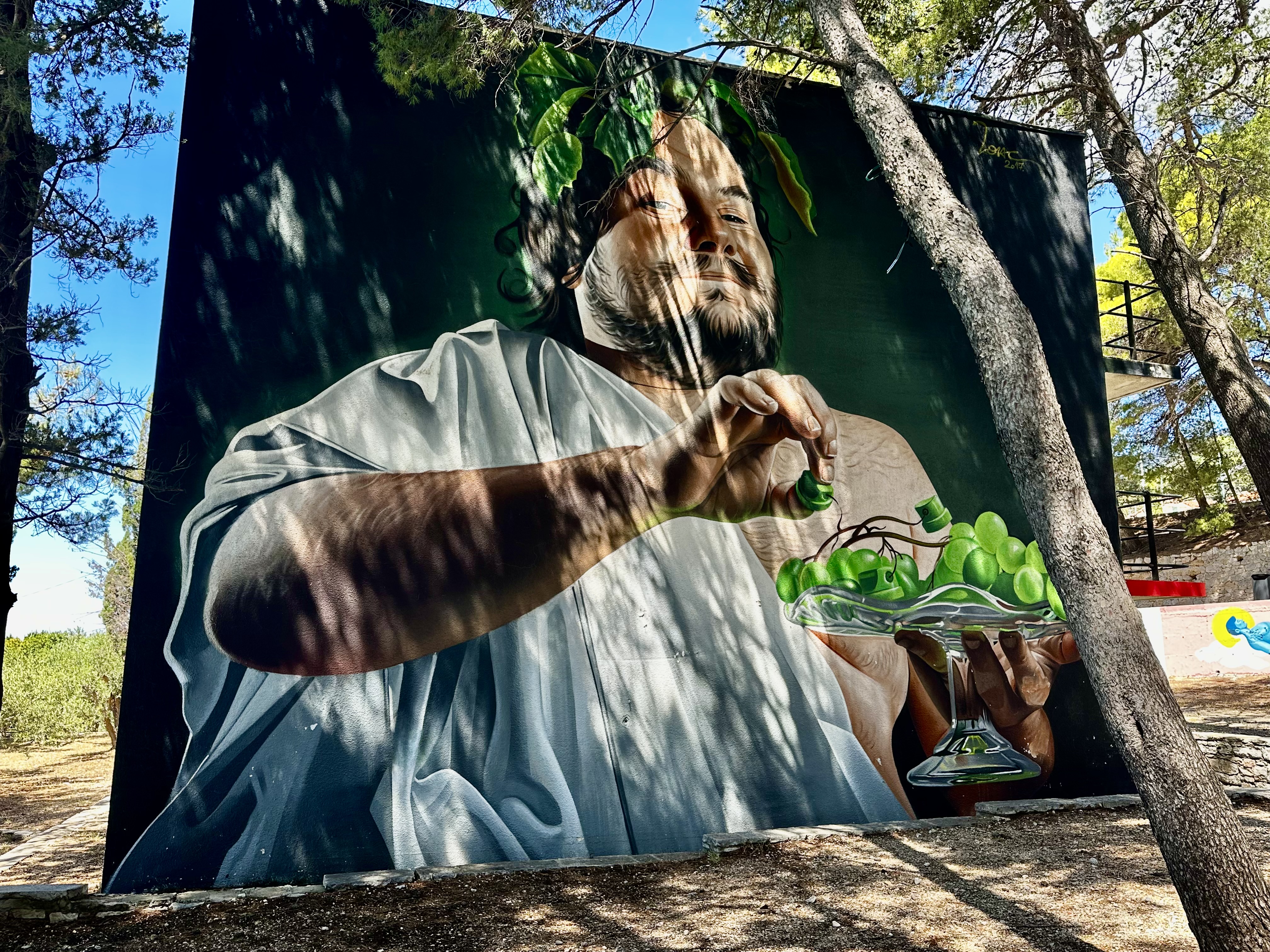
It is hard to believe that we are winding down this wonderful trip to Croatia. The coast of Croatia is beautiful. Each day the sun comes out, the water sparkles many shades of blue, giving us (Zee and I) the time to explore and discover new things.
We remained on Brač in the town of Bol for one more full day. Finally, we had time to wander for a full day. This town was quaint and unhurried. First we walked in one direction and then in the other, discovering interesting sites along the way.
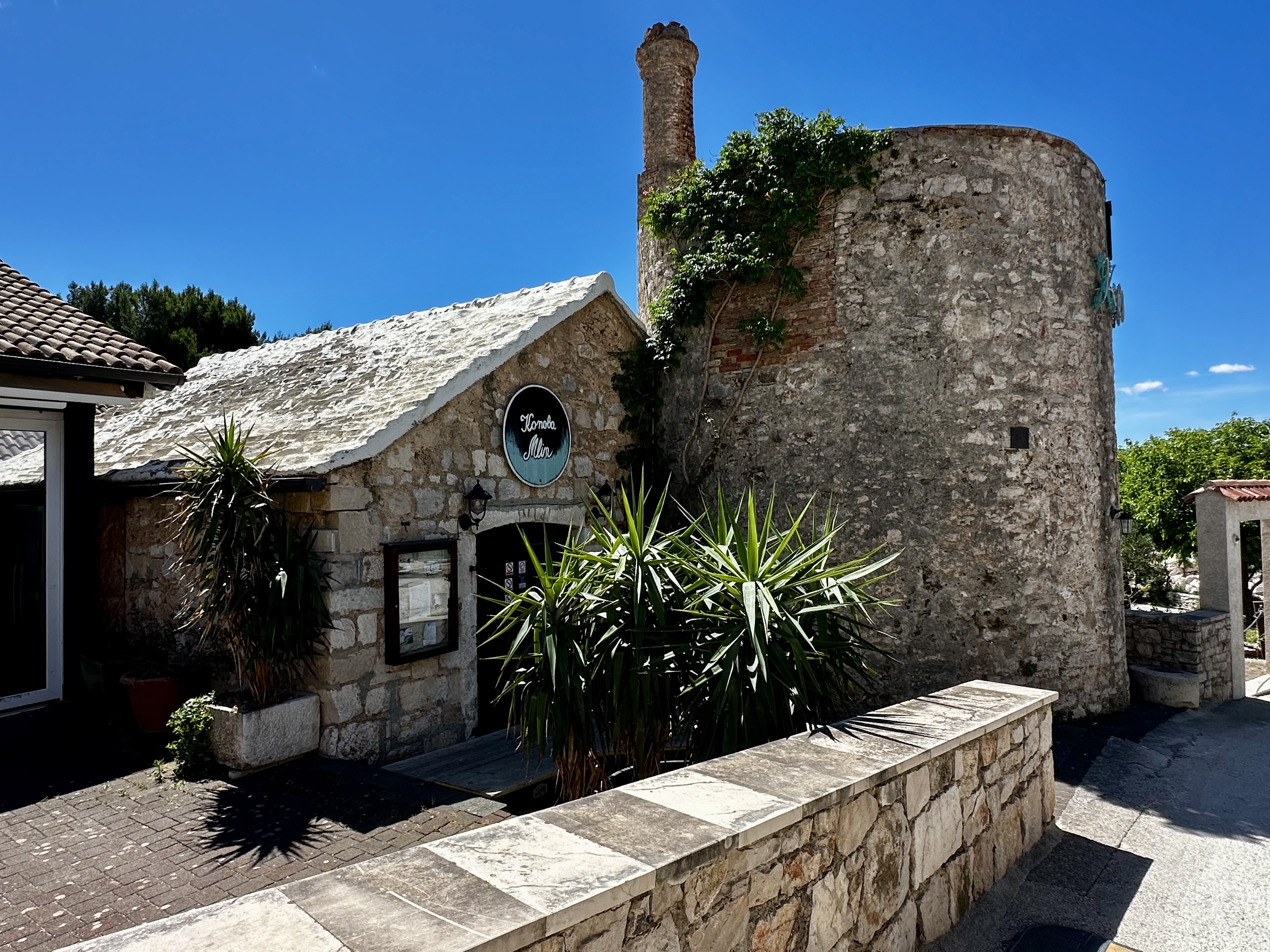
These photos capture part of our walk to the church and the Dominican Monastery Museum.
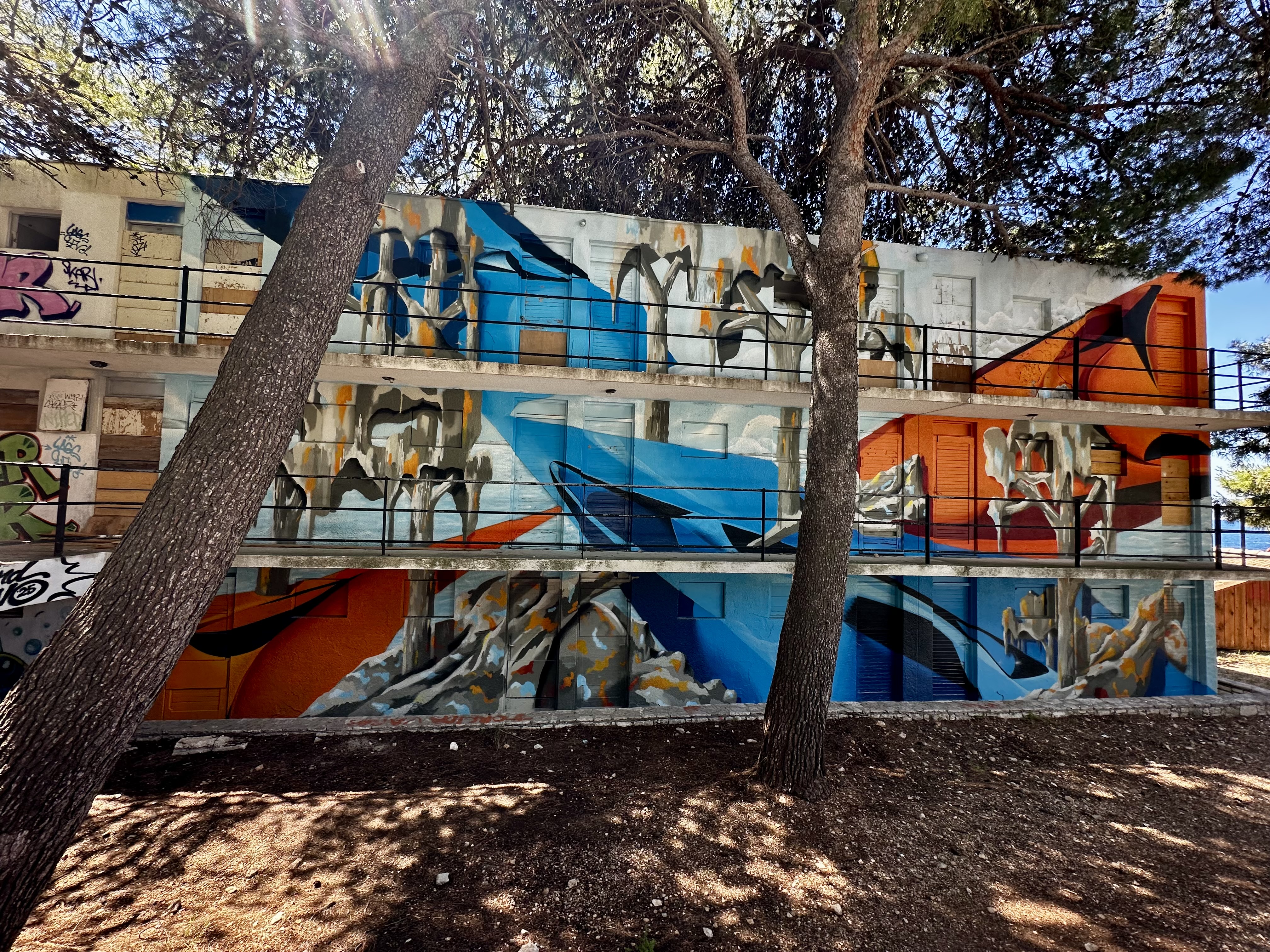
On our way to the Dominican Monastery, we came across this abandoned hotel.
It sits perched above a small pebbly beach on the eastern edge of town and enjoys uninterrupted vistas across dazzling azure waters to the wooded hills of Hvar, just to the south.
You can’t stay there, sadly. It was abandoned when tourists stopped coming to the island of Brać during the Balkan Wars.
In the early nineties it was used to house refugees. But when the war ended, and they moved on, it was stripped of anything valuable and left to fall into disrepair.
There’s always talk of it reopening. But a dispute with the Dominican Monks in the nearby monastery is complicating negotiations. The hotel had originally been a Dominican school, you see, and the monks were forced to sell it by greedy Communist officials keen to turn a quick profit.
The murals are painted by artists who gather here every July for Graffiti Na Gradele.
For five days each year the hotel becomes a hive of activity.
Streets artists come from all over the world to paint over last year’s efforts and create new masterpieces of their own. There are workshops for local kids, Hip-Hop concerts and even rap battles.
And then the hotel goes silent again.
The Dominican Monastery museum in Bol is one of the largest and wealthiest museums on the island of Brac. The Dominican Monastery is located on the east side of Bol, on the Glavica peninsula. It was reopened to the public in 2021, harmoniously blending modern design and cultural and historical treasures.
Next to the Dominican monastery is a church of St. Mary of Mercy, built and rebuilt at various stages throughout the 16th century. It received its present-day Baroque form in 1641. The main altar, dedicated to the Blessed Virgin Mary, is the work of the world-famous Venetian painter Jacopo Tintoretto. The authenticity of the painting is confirmed by records of the monastery archives, which describe the acquisition of this precious painting in detail.
Then we walked in the other direction. We discovered Wind-surfers, and learned that this area is a place where championship windsurfing competitions are held. Competitors arrived from all over the world to compete.
The following morning we drove across the island of Brasc to meet the ferry. Our time on this lovely island had come to an end and we were off to Hvar. Tomorrow Hvar. I promise.
But not before we met up with one more of the feline population.
Zee and I arrived in Croatia three days ago. It is very different than Türkiye. It is more modern, we don’t see any of the squatty potties we saw throughout Türkiye, more people speak English and it just feels esaier to move around.
For three days we stayed in Split a small town centered around a Palace, the Diocletian Palace. The history of the city of Split is inextricably linked to the Roman emperor Diocletian and his stunning palace which was built for the purpose of his retirement in the year 305.
Diocletian’s palace is one of the best preserved and most impressive monuments of the Roman era in Europe, and it has been on UNESCO’s World Heritage List since 1979. The palace was built to serve several purposes and combined imperial residence, a military fortress, and a fortified town. Even though its original structure changed and altered over the centuries, it is still, even today, the very heart of the city of Split packed with bars, restaurants, shops, and people wandering around, absorbing the vibrations of the streets.
Diocletian was born around the year 243 in Roman Dalmatia, probably somewhere near Salona, with the name Diocles. He began his career as a soldier, defending the distant borders of the Roman Empire and conquering new ones. Diocletian was proclaimed emperor in the year 284 with the title The Emperor Gaius Aurelius Valerius Diocletianus. He ruled for twenty years, which was a relatively long time at that period. He abdicated voluntarily and retired to the palace he had built in his Dalmatian homeland. At that time, the ancient settlement of Aspalathos, Latin Spalatum, was known as a small fishing port and had no possibility of advancement due to the great development of nearby cities, such as Salona and Trogir. The situation changed after Diocletian decided to spend the last days of his life precisely in Spalatum.
It is assumed that the construction of the palace lasted for 10 years. Diocletian’s palace was a very strong fortress that occupied an area of more than 30,000 m². It was constructed with stone transported from the island of Brač, in addition to marble from Italy and Greece, as well as the columns and 12 sphinxes from Egypt. The palace actually contained an entire city with streets, squares and buildings that served different purposes. The southern façade of the palace was located right on the coast. The other three facades were located on land and together with the southern façade closed the rectangular shape of the palace.
Golden Gate
The Palace was divided into four parts by the two main streets intersecting in the middle: the guards and military were situated in the northern, while Diocletian’s residence was in the southern quadrants. Each wall of the palace had a gate at its center, named after a metal: northern Golden Gate, southern Brass Gate, eastern Silver gate, and western Iron Gate. In ancient times, Brass Gate opened straight from the water into the palace basements, enabling goods to be delivered directly from the ships and stored there. Today, Brass Gate is the main entrance into the palace from the Riva.
After Diocletian died, his Palace became imperial property. At the beginning of the 7th century, after the devastation of nearby Salona, Diocletian’s palace provided shelter to the exiled inhabitants who were defending themselves from the invading barbarians. This period also marked the beginning of organized city life inside the Palace. During the following centuries, the area of the city of Spalatum expanded and parts of Diocletian’s palace were destroyed, while other structures were built inside it. The city gradually spread around the Palace and by the 15th century, it doubled in the surface. Today, Split is the largest city in Dalmatia and the second-largest city in Croatia.
The Silvert Gate
The terraine here reminds me very much of southern California. It is a mediterranean climate so it should not surprise me that things look a lot like where I am from. On one of my adventures through town I found a massive Bougainvillea. Many of the flowers are the same as well. What is very different is the very blue Adriatic Sea.
The Second day we signed up for a tour that lasted for most of the day. We visited the UNESCO world heritage site, the town of Trogir and then prceeded to one of Croatia’s National Park, Krka Falls. It was a fascinating day with a bit of diversity in it, from town to nature and back again.
The Historic City of Trogir on the eastern coast of the Adriatic is a remarkable example of urban continuity. The orthogonal street pattern of this island settlement dates back to the Hellenistic period, and it has been embellished by successive rulers with many fine public and domestic buildings and fortifications. Its fine Romanesque churches are complemented by the outstanding Renaissance and Baroque buildings from the Venetian period. Its urban fabric has been conserved to an exceptional degree and with the minimum of modern interventions, in which the trajectory of social and cultural development is clearly visible in every aspect of the townscape.
The ancient town of Tragurion was founded in the 3rd century BC as a trading settlement by Greek colonists on an island at the western end of the bay of Manios between the mainland and one of the Adriatic islands. The town was enclosed by a megalithic wall and its streets were laid out on a grid plan. The town has been in continuous occupation since then. Its contemporary plan reflects the Hellenistic layout in the location, dimension and shapes of its residential blocks. The two ancient main streets, the cardo maximus and the decumanusare still in use.
The development of the ancient town is clearly expressed in the town plans. Ancient Tragurion lies at the eastern end of the islet; this spread out in the earlier medieval period, and the plan of two concentric circles of houses and streets, within the former walls, is still visible. The medieval suburb of Pasike developed to the west on a different alignment, and was enclosed by the later fortifications. The port was located on the south side. Finally, the massive Venetian fortifications incorporated the Genoese fortress known as the Camerlengo. The townscape of Trogir is determined by the pattern of, for the most part, narrow streets. Its homogeneity is stressed by the predominant local limestone, now mellowed by time with a golden patina.
The Krka National Park has held national park status since 1985 and is one of the most popular and well known of Croatia’s many natural attractions.
Being barely spoilt by humanity, this large expanse of 109 square kilometres is wild and attractive, boasting the highest density of wild lavender in Europe and sustains a variety of eco-systems.
Nearly 900 different plant species live within the park, as well as over 200 bird species and 18 different types of fish from trout to the Dalmatian Barbel Gudgeon.
The national park is also home to some of the most impressive waterfalls in the country.
At the end of the day we took a twenty minute boat ride to the town of Skadin before we returned to Split. It was a full day and a good day. As I walked along the boardwalk trails I enjoyed listening to the frogs and birds. It was nice to be in nature for a part of my day. Nature is always so important for my healing self.
Today it has been raining, thunder, lightning included for free. We took the boat to Bol. for two nights and now will be on some of the Croatian Islands before ending the trip in Dubrovnik in about 10 days. Stay tuned there is more to come.
And they are still loved and protected in Croatia. They have been loved and cared for since the plague. It was discoved if you had cats around the rats were killed. No Rats – No Plague. Yay kitties.