Discover the Hidden Gem of Point Roberts, WA

Just south of Vancouver BC is a point of land known as Point Roberts. Point Roberts is surrounded on three sides by water. It is bordered by Canada to the north. It is part of Washington state and the United States. The only way to get there is by car crossing the International Border or by private plane or boat.

On a sunny early summer morning I decided to visit Point Roberts. I drove from Richmond (south of Vancouver). I crossed the International Border and spent a late morning and afternoon touring this unique area of the United States.

Point Roberts was created in the mid-19th century. At that time, the United Kingdom and the United States settled the Pacific Northwest American-Canadian border dispute. They resolved the issue with the Oregon Treaty. The two parties agreed that the 49th parallel would define The boundary between their respective territories. The small area that incorporates Point Roberts is south of the 49th parallel.

During the 1858 Fraser gold rush, prospectors from Victoria, BC attempted to avoid tax collection. They briefly settled Point Roberts. Their settlement was called Robert’s Town. It consisted of six wooden buildings, including a store and saloon. It lasted less than a year.

In 1949, there was talk about Point Roberts seceding from the U.S. and joining Canada. In 1973, a drought that caused the wells to run dry created tensions between Point Roberts’s U.S. and Canadian residents. The Americans threatened to cut off the Canadian residents’ water supply. They also hung up signs saying “Canadians Go Home.” This was unless the Canadian municipality of Delta agreed to supply water. An agreement was signed on August 28, 1987. It requires the Point Roberts Water District to buy raw water each year.

During the COVID-19 pandemic, Point Roberts was acclaimed as the “safest place” for avoiding coronavirus. This was due to its isolation from the mainland United States and Canada. The very low case numbers also contributed to this reputation. Limited access to the rest of the United States and Canada was a factor. Additionally, border closures into Canada kept the case numbers very low.

As the pandemic worsened in both countries. In 2020, a study found that Point Roberts had lost 80 percent of its business. It also lost hundreds of seasonal residents. This was a result of the pandemic and border shutdown. The area was described as a “ghost town” by the local chamber of commerce director. It had no confirmed cases of COVID-19 as of September 2020.

The Port of Bellingham set up a temporary ferry in August 2020. It connected Point Roberts to the mainland. The Canadian government waived its mandatory COVID testing requirements for Point Roberts residents in 2021. The decision followed negotiations with Washington state. The border was fully reopened for non-essential travel in August 2021 and the ferry service ceased the same month.

The City of Delta installed a chain-link fence at the end of English Bluff Road in 2025. This was done to deter accidental crossings. An elderly man accidentally walked into Point Roberts. The fence was poorly received by local residents and at least one Delta council member demanded its removal.

The Marina

Approximately 1300 people live in the 5 square mile area of Point Roberts. The big attraction is the nature and the wildlife. Point Roberts has it all. The community has a golf course, a marina and two restaurants.There are four parks and coastal beaches to explore.

Lighthouse Marine Park is a 21-acre park on the Salish Sea and my first stop. Park amenities include a boardwalk, picnic areas,playground, trails, boat launch, and 30 campsites for weekend of camping. I chose to walk the beach trail to gaze out on the water. I hoped for whales but a seal was all I saw.

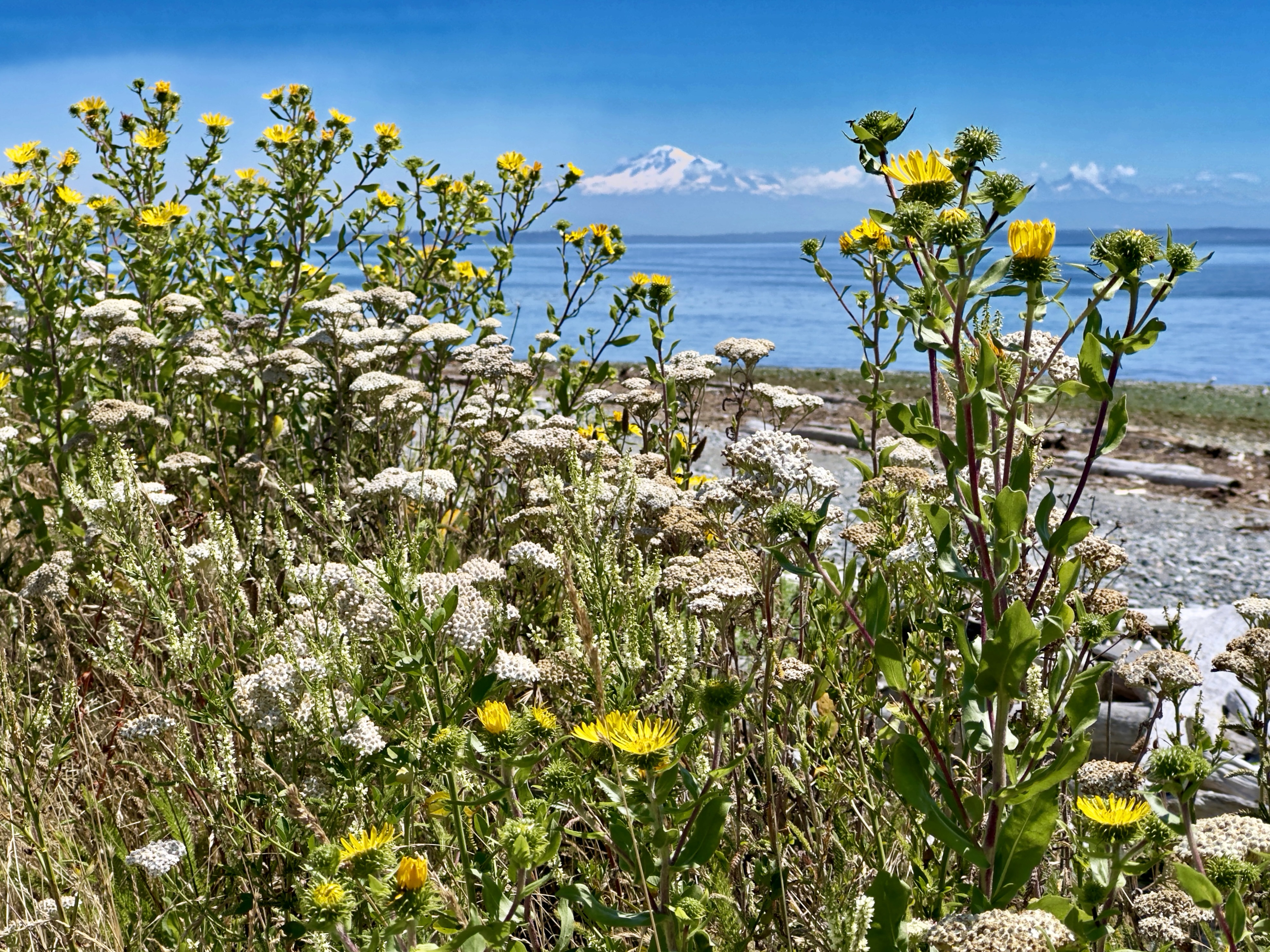
Mt Baker from Lighthouse Park

On a beautiful day I saw Mt Baker on the mainland, in Washington State. The beaches are like the beaches in Washington, Plenty of drift wood was scattered along the beach. The beaches are rocky and wild.

Monumet Park

This park is known for “Border Marker Number One”. It is the western most border marker between the U.S. and Canada. The park is a canopied forest of cedar and fir trees.

Lily Point Marine Reserve Park

Lily Point Marine Reserve spans 275 acres of forested upland and beaches. It is known for its towering sandstone bluffs. When beach-side, pilings can be seen running out into Boundary Bay. These pilings are remains from the Alaska Packers Association cannery. This cannery once operated here in the late 1800s.

Maple Beach

This beach is a popular spot for beach combing and swimming. It sits on the northeastern corner of Point Roberts. It is known for its sandy beaches and tidelands. At low-tide the tidelands stretch for a mile or more.

After a morning and early afternoon exploring I stopped for lunch at Kiniski’s Reef Tavern. The food was good and the view from outdoor seating was exceptional as I looked out over the Salish Sea.

Somewhere along my travels I read about Ollie-Otter’s Baker Box. I decided I needed to go find this interesting local landmark. There is a cottage bakery there Ollie-Otter’s Bakery is in a cottage behind the bakers box on the curb side. There were wonderful goodies waiting to be bought.

The Hungry Hound Barkary had a small box next to the street side bake box. This business is owned by Ollie Friedman. Ollie may have some growing to do but he has big dreams.

This is what is written on the sign in the photo.

“Hi I am Ollie. I own the Hungry Hound Barkary. Yep I’m 11 but I have BIG dreams. Someday I want to be an astronaut and work for NASA. To make that happen I need coding classes. So to raise money I’m taking over the dog treat business. Thanks for stopping and supporting my dream. I hope your pup enjoys the retreats.”

If you would like to support Ollie’s Dreams here is the link to his Go Fund Me Page. Ollie’s Path to NASA. I believe, much like my husband did, that it is important to support these young people no matter their dreams.

After a lovely morning and afternoon, I approached the International Border. I crossed back into Canada for a few more nights. Before I made my way back to the United States.

I enjoy exploring the unknown. I definitely would return to Point Roberts again. I could easily see camping there and taking a leisurely tour of the area.

I am grateful for my friends. They guide me to unusual places. This year I can add Point Roberts to places that are unique.

Today, as every Day I am Thankful.

.

.

Cross-Border Kindness: My RV Journey Discovery

Kindness” is a type of behavior marked by acts of generosity, consideration, rendering assistance, or concern for others, without expecting praise or reward in return.”

Spending time with friends is essential to me. Friends can be people I know or meet along my journey with EmmyLou (my RV) and people already in my life.

Recently, I spent time with a friend, and we talked about the kindness of people. She stated that people in Canada were kinder than in the United States. I believe that kindness crosses borders without thought of the country.

I believe that people are inherently kind. When I have needed help, invariably, someone has come to my aid. I have had help from strangers, fellow RV’ers, and from friends. I have never felt alone and helpless because someone has always offered me help, a place to stay, a shower, company, sometimes a voice at the other end of the phone, and so much more.

I know there is always an example that can show how people are kind or unkind, helpful or unhelpful. Yet, I believe most people worldwide are inherently kind and want to help and befriend others in their time of need.

Early on this RV journey, just as I went full time, I made a stupid mistake and drove when I was tired. I drove over a boulder in a Box Store Parking lot, and when I backed off, I pulled my front fender off. I do not handle this kind of situation well. Thanks to my good Roadside Assistance plan, they could send a mechanic to help. While this person was arriving, a couple in a BIG RV came over, and with everyone’s assistance, the bumper was secured to the rig. The next step was to get it fixed. Enter a stranger with a Roadtrek (the RV brand). When she found out where I needed to go to get the front end fixed (her hometown), she offered me a place to stay for the week and picked me up from the dealership. Mary and I have become strong and good friends since then. 

Not all my experiences have been that dramatic, but time and again, I have encountered the kindness of strangers and friends. We might not share similar beliefs or ways of life, but we all share the willingness to help, offer compassion, and be kind.

Kindness does not come without some preparation in one’s life. As I was researching for this post, I found the information below, and it made me pause and think about how I can learn to be kind and encourage others to be kind.

“How to Be Kind: 6 Ways to Be Kind”

Written by MasterClass

“Focusing on kindness can help make you a better person, encouraging you to be more generous and patient with the people around you. Here are a few tips for how to be kind in your life.

Give others the benefit of the doubt. Judging people and situations prematurely without having all the facts is easy. Remember that other people can go through difficult times just like you. If someone mistreats you or ignores you, there may be a hard battle in their life that’s making it more difficult to be kind, whether it’s a mental health challenge or a bad day. Be kind by giving them the benefit of the doubt rather than jumping to conclusions and getting upset.” Oooh, this is an essential thing for me to remember.

Identify your biases. Sometimes, you may have unconscious obstacles to your empathy that prevent you from practicing unbiased, true kindness. Think about the small decisions you make and whether you may have prejudices. Consider taking an unconscious bias course to learn how to overcome these biases so you can be kind to everyone—regardless of gender, race, sexual orientation, ability, or other characteristics. 

Practice gratitude. Kindness can stem from the feeling that you have enough of what you need—tangible items (like food or income) or intangible things (like respect or love). To help yourself become a kinder person, regularly practice gratitude to remind yourself of all the good stuff you have.” And this leads to Self-Compassion.

 “Start with self-compassion. Being kind to everyone in your life includes being kind to yourself. Remember to prioritize your physical and emotional well-being and employ the same kindness techniques on yourself for friends, family members, loved ones, and others. Your self-care tactics may include complimenting yourself to boost your self-esteem, treating yourself to an activity you enjoy, or encouraging yourself to take time each day to relax and unwind. 

Think about how others want to feel. The “golden rule”—you should treat others the way you want others to treat you—is a great place to start when performing kind acts. However, a valuable variation can help increase the effectiveness: think about what others ask for and treat them the way they want. Everyone has different preferences and love languages, and sometimes, what they wish to differ from what you would like in the same situation. To spread kindness, make a conscious decision to meet their needs. For example, if you know your partner prefers acts of service over gifts, try to perform a small service (like offering to clean up) rather than giving presents, even if you prefer to receive gifts.

Try random acts of kindness. Random acts of kindness are the good deeds you do without prompting or expecting something in return. These can be simple acts that help people in small ways. For example, you may let a stranger ahead of you in the grocery store checkout, pay for someone’s cup of coffee, bake brownies for a struggling friend, reach out to someone who seems lonely, or send a kind note to your coworker’s inbox. Small acts of kindness are a simple way to remind others they deserve love, and they can encourage others to do the same for the people around them, generating a far-reaching positive impact.”

Whenever I experience kindness from people, I want to put myself out more for others. Maybe that is the benefit of empathy and compassion. We experience it, which encourages us to reach out to others and learn more about compassionate understanding.

Today, I am thankful for all those moments of kindness and support from others. Today, I am grateful for this cross-border experience. Today, I am thankful to allow contemplation on such a rich, deep topic.

Today I am thankful.